|
SECRETS OF THE LEGAL INDUSTRY
Litigation Tool #10.003
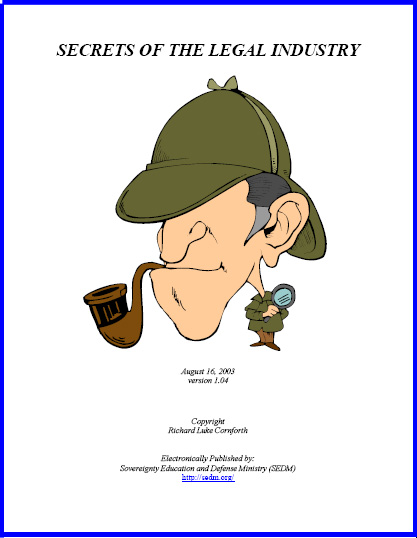
209 pages;12 chapters
 Click here
for a sample
Click here
for a sample
|
The
Secrets of the
Legal Industry book is a companion to a seminar
by the same name given all over the country by Richard Cornforth
of Oklahoma. A set of video tapes are also available covering
the seminar, but we do not offer the tapes. The book is
primarily intended for people who want to litigate in court
and represent themselves as what is called a "Sui Juris".
It covers many very important elements of civil and criminal
litigation that are essential to the budding lawyer, including:
- Civil procedure
- Void judgments
- Civil rights enforcement
- Standards of evidence
- Discovery issues
The forms presented in the book are not editable. The
author prohibited us from providing editable copies of the book.
|
The book is provided
only in electronic format. You can easily and inexpensively
make your own paper copy of the book at any Fedex/Kinkos or printing store
if you follow the instructions on its cover sheet.
Click here if you are having
trouble downloading or viewing or using the above document
NOTE:
You will need WINZIP installed on your computer to unpack and view
this document, which is available from
http://www.winzip.com.
You will also need to download and install the free
Adobe Acrobat Reader version
4.0 or higher from the Adobe website at
http://www.adobe.com in order
to view or print the document. If you don't update to
the very latest Acrobat reader, then you may get errors opening
or reading the document. We recommend that you also click
on the "Show/Hide Navigation Pane" button in the left portion of
your screen in order to simplify navigating around in this rather
large (129 page) document.
If you would like to reach Mr. Cornforth,
you may do so at the contact below. Richard is a very busy man
and we don't recommend calling him for free legal help, because he doesn't
provide it. You may contact him if you have suggestions or comments
about his book, however:
okcorn4th@aol.com
Below is a complete outline of the content
of this very extensive work:
PREFACE
Revision History
Table of Contents
Table of Authorities
Cases
Statutes
Regulations
Other Authorities
1. SECTION ONE: INTRODUCTION
1.1 We Have a two tiered court system
1.2 We have a common law court system
1.3 The real law is found in the annotated statutes
1.4 There are two types of jurisdiction relating to people
2. SECTION TWO: THE LAW
OF VOIDS
2.1 Everything You Always Wanted
to Know About Void Judgments But Were Afraid to Ask
2.2 Reasons why subject matter jurisdiction CAN be lost
2.3 Summary of the Principles of the doctrine of law of voids
2.4 Sample petitions to vacate
3. SECTION THREE: THE
FAIR DEBT COLLECTION PRACTICES ACT (FDCPA)
3.1 Overview of the Fair Debt Collection Practices Act (F.D.C.P.A.)
3.2 Note and Contract Law
3.3 Phone scripts to use with Third Party Collectors
3.4 Early letter to collector
3.5 Late letter to collector
3.6 Sample suit for damages
4. SECTION FOUR: CIVIL
LITIGATION
4.1 Is your lawsuit frivolous?
4.2 Sample case
4.3 Have you really failed to state a claim upon which relief
can be granted?
4.4 Sample Case
5. SECTION FIVE: APPEALS
5.1 Sample state appeal
5.2 Sample federal appeal
6. SECTION SIX: DEALING
WITH ADMINISTRATIVE AUTHORITY
6.1 Sample suit for judicial review of administrative action
6.2 Priddy v. City of Tulsa
7. SECTION SEVEN: CIVIL
RIGHTS ACTIONS
7.1 Malicious prosecution
7.2 Denial of remedy
7.3 False imprisonment/imprisonment for "contempt"
8. SECTION EIGHT: ATTACKING
THE INTERNAL REVENUE SERVICE
8.1 Remedies
8.2 Would you believe that a RACS 006 is not an assessment?
8.3 Sample of suit for violation of collection practices guidelines
8.4 Sample suit for relief of conviction for evasion and/or
willful failure
9. SECTION NINE: CIVIL
RICO
9.1 Overview of Civil R.I.C.O.
9.2 First draft for a Civil R.I.C.O.
9.3 Advanced R.I.C.O.
9. SECTION TEN: STRATEGIES
10.1 Supremacy and equal protection of the law
10.2 Affidavits
10.3 Objections
10.4 Notice of lis pendens
10.5 Preliminary injunction
10.6 Writ of mandamus
10.7 Writ of prohibition
10.8 Deposing them
10.9 Being deposed
10.10 Interrogatories
10.11 Admissions
10.12 Bankruptcy, using the law of voids under 11 U.S.C. §9014
10.13 Defending against a motion for summary judgment
10.14 Defending against a motion to dismiss
10.15 Quo Warranto (Courtesy of Marcel Bendshadler)
10.16 Complaint against a federal judge or magistrate
10.17 Using a Declaration to Compel Action
11. SECTION ELEVEN: RESOURCES
12. SECTION TWELVE: THE POLITICAL
SOLUTION
|